
Connecting People, Place, and Culture: Reflections from our CHerPP first findings event
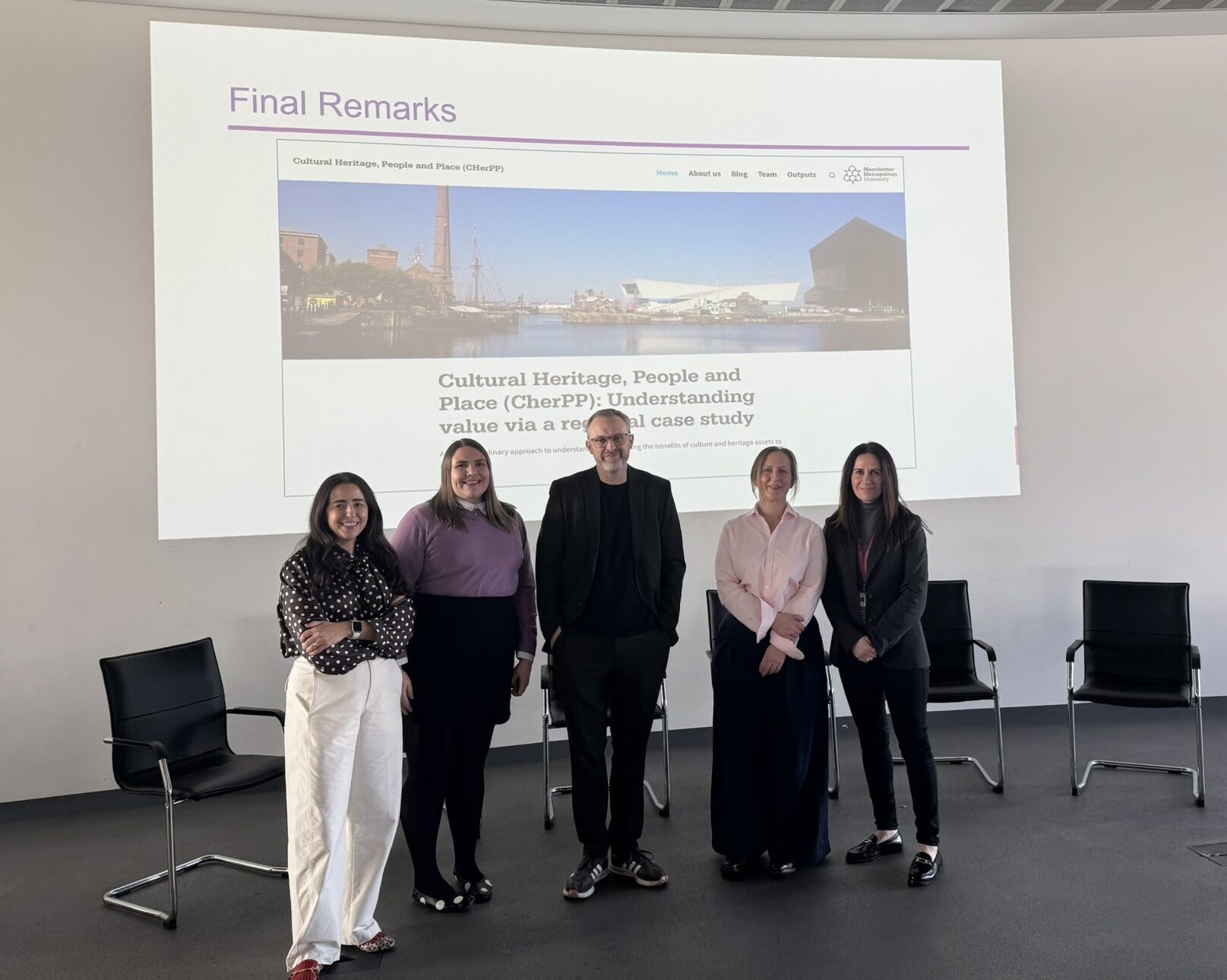
This week, the Cultural Heritage, People and Place (CHerPP) project brought together researchers, cultural practitioners and policy stakeholders at the Museum of Liverpool to discuss the project’s first findings and reflect on how cultural heritage creates value for communities.
Funded through the AHRC–DCMS Culture and Heritage Capital programme, the project explores the often overlooked non-market values of culture and heritage, particularly so-called non-use values—the importance people attach to cultural assets even when they do not directly visit or interact with them. These values are typically understood through concepts such as altruistic value, bequest value, or existence value, yet they remain difficult to capture using conventional evaluation tools such as social cost-benefit analysis.
That the event took place at the Museum of Liverpool – with a view of both the museum led redevelopment area and the river and its surrounds -was fitting. Our project has used the Waterfront Transformation Project, and with it the National Museums Liverpool (NML) collections and sites, to explore the nuance and diversity of connections and values beyond direct recent visitation. This regional approach was key to understanding and testing the non-use values of cultural heritage in all their complexity. Our mixed methods approach provided a means of accessing, coding and synthesising rich and necessarily complex qualitative data and developing this into a place and context sensitive regional hybrid choice model survey. However, the richness and complexity of the data was never going to easily sit within boundaries and the discussions we held in Liverpool were a first step in showcasing the possibilities- and limitations- of our approach.
Morning Sessions: Setting the Scene
We opened with Claire Benjamin, Head of Learning and Engagement at NML, who shared an overview of the CHerPP project from the perspective of our research partner. She then welcomed the Heads of the Museum of Liverpool, the Maritime Museum, and the International Slavery Museum to provide further insight into the Waterfront Transformation Project and the broader cultural landscape it sits within.
CHerPP project lead Tamara West then presented a brief overview of CHerPP, before inviting reflections on the qualitative focus groups from the perspective of two people who had been integral in helping to facilitate some of them – Nasra Eliot (NML), who attended the Liverpool 8 and the Walton groups, and Zi Lan Liao (Pagoda Arts), who translated our discussions with Cantonese speaking elders. Both Nasra and Zi Lan spoke to the complexities of community connections and disconnections to the waterfront, highlighting issues ranging from non-belonging, touristification, traumatic experience, and intergenerational memory though to the need to understand how the museums act as complex emotional anchors. Our qualitative findings echoed the importance of museums addressing difficult histories even when this creates emotional discomfort or deters repeat visits.

CherPP Co-lead Rafaela Neiva Ganga and Researcher Laura Taggart took the stage to present an aspect of the coding of the qualitative workshops – echoing the previous presentation findings that benefits and disbenefits, and use and non-use, are not easily defined when applied to cultural heritage. The translation of this in depth research into useable quantitative measures was no small task. CHerPP Co-Lead Steve Nolan picked up this discussion, presenting the hybrid choice model, discrete choice experiment, and initial findings. Tamara returned to wrap up the morning with a summary of the emerging picture: existing metrics rarely capture non‑use values in full, meaning these important dimensions are often overlooked or reduced to user‑only evaluations. Value, as our findings show, can be inherited, symbolic, emotional, indirect, or mediated—not only tied to physical presence.
Afternoon Panel Discussions: Regional and National Perspectives
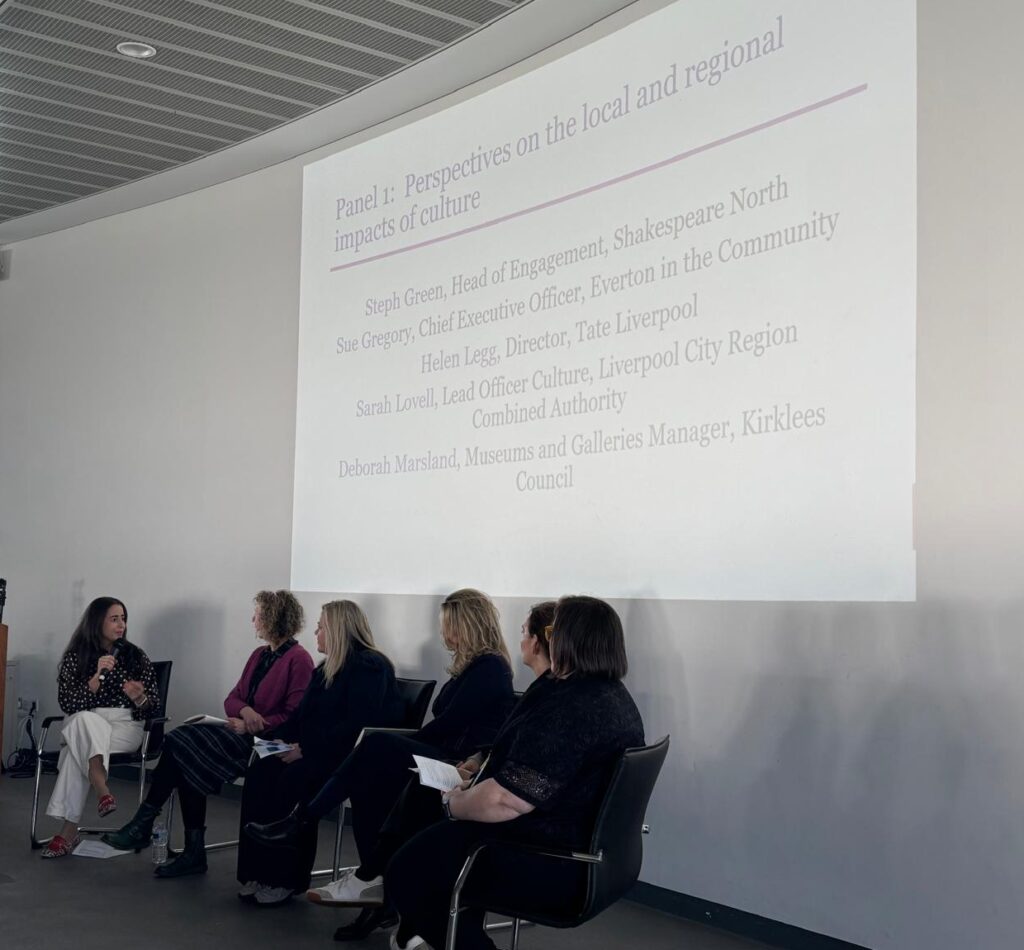
The afternoon welcomed regional and national contributions to our discussions. Our first panel, Perspectives on the Local and Regional Impacts of Culture: a discussion of non-economic values of culture and heritage from across the region and beyond was chaired by Rafaela and welcomed Steph Green, Head of Engagement at Shakespeare North; Helen Legg, Director, Tate Liverpool; Sarah Lovell, Lead Officer Culture, Liverpool City Region Combined Authority; Sue Gregory, Chief Executive Officer Everton in the Community; and, with a perspective from beyond the region, Deborah Marsland, Museums and Galleries Manager, Kirklees Council. Their discussion emphasised the complexities of capturing non economic value and the deeply rooted social benefits generated by regionally embedded cultural organisations.
Next, we welcomed the Department for Culture, Media and Sport (DCMS), co‑funders of CHerPP. Harman Sagger, Head of Cultural Analysis, introduced the Culture and Heritage Capital (CHC) framework. This set the stage for our second panel: Capturing and Evidencing the Values of Culture and Heritage, chaired by Tamara, which brought together representatives from the other AHRC–DCMS funded CHC projects represented by Dr Amy Binner, Exeter University; Ms Adala Leeson, Historic England; Prof Karen McBride, Portsmouth University; Dr Ricky Lawton, IPSOS; and Prof Patrizia Riganti, University of Glasgow. Together, they highlighted both the challenges and the necessity of mixed‑methods, interdisciplinary approaches, and the importance of sharing models and learning across projects.

Looking Ahead
While CHerPP still has a few months left of analysis and dissemination, this event marked an important milestone. It gave us space to reflect on the work achieved so far, thank collaborators, share our early insights, and open up rich discussions about the work still to come.
We’ll continue developing and sharing our findings in more detail in the months ahead, as well as applying and extending our learning in both national and international contexts. More reflections and findings will be shared very soon!